

The Untapped Leasing Advantage
Why Multifamily Needs to Embrace the Micro-Influencer and Sphere Marketing Model
Friday, August 15, 2025
The Untapped Leasing Advantage
Take by

Micro-influencers aren’t just for fashion brands. In leasing, they’re often the first touchpoint for a renter’s decision — and they convert better than paid ads.But there’s another channel properties underestimate: local sphere marketing. The agents and locators whose referrals come from past clients, neighborhood contacts, and years in the community. The ones who get 10+ referrals a month without posting a single reel.The two combined are a leasing machine: social reach drives awareness, local trust drives the signature on the lease.If your strategy ignores either one, you’re leaving the highest-ROI marketing channels untapped.
The way renters decide where to live has changed. They’re not just combing through listings anymore — they’re gathering signals from everywhere: Instagram reels, casual conversations, the friend-of-a-friend who “knows someone,” and the local who seems to always have the inside scoop on the best deals in town.
For other industries, this shift has already happened. Beauty, fitness, and direct-to-consumer retail all embraced influencer marketing years ago. The multifamily industry, however, is still running a playbook that’s too heavily weighted toward static ads and new-build social accounts with no established audience.
It’s time to talk about the two channels that, when combined, can outpace almost any other marketing spend: micro-influencers and local sphere marketing.
Micro-Influencers: The Credibility Engine
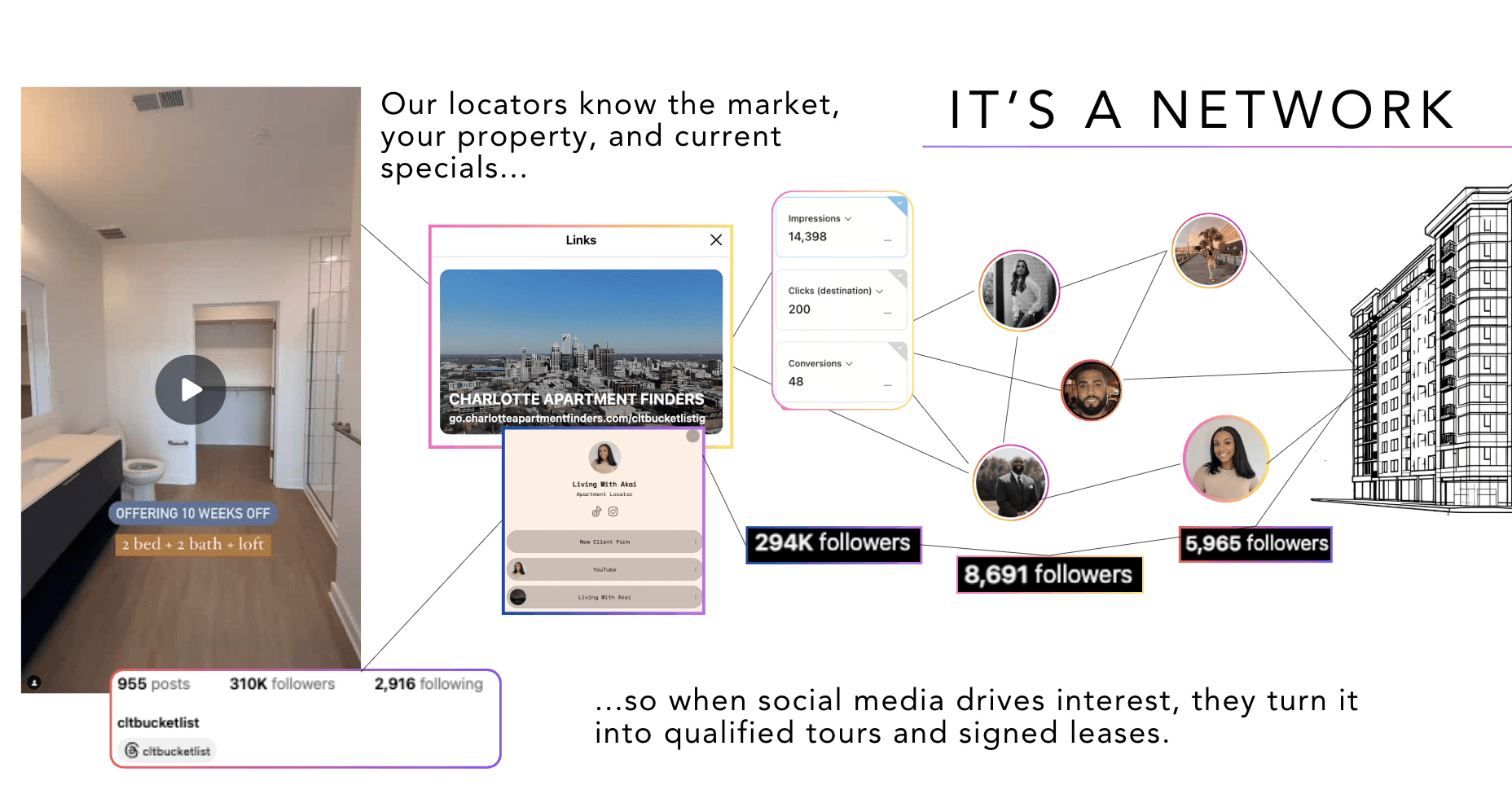
Micro-influencers (5,000–50,000 followers) consistently deliver higher engagement than their macro counterparts, often at a fraction of the cost. Their niche audiences trust them because they don’t feel like corporate spokespeople.
They’re not just promoting products — in real estate, they’re showing real apartments, in real neighborhoods, in real time. And their viewers are often actively looking for a place to live.
This model works. Studies show influencer marketing generates an average ROI of $5.78 for every $1 spent, with micro-influencers outperforming larger accounts on cost-per-conversion.
In Charlotte, our exclusive CLT Bucket List partnership reaches over 500K locals and converts social leads to leases at a 15–20% rate — numbers that traditional ILS ads can’t touchCAF x CLT Bucket List -….
Sphere Marketing: The Overlooked Powerhouse
Not all influence lives on a social platform. In every market, there are agents, locators, and community connectors whose business thrives on the strength of their personal network.
This is sphere marketing — the referrals and introductions that come from years of working in the same neighborhoods, serving the same clientele, and building genuine trust in the community. It’s the bartender who tells a regular about your service. The concierge who knows you can place their friend’s kid in a good building. The past client who sends you three more people over the next year.
These referrals don’t show up in your Instagram analytics, but they show up on the rent roll. A seasoned local can generate 10–15 qualified referrals a month without a single paid ad, simply because their name carries weight in the market.
For properties, tapping into that network is just as valuable — if not more so — than landing a spot on a “Top 10 Apartments” reel. It’s a trust transaction, and trust drives leasing decisions faster than any banner ad ever could.
Why the Two Work Best Together
Micro-influencer marketing is the high-visibility top of the funnel; sphere marketing is the high-trust mid and bottom. One generates curiosity, the other converts it.
Influencer reach puts the property in front of a targeted audience quickly.
Sphere credibility turns that awareness into a personal recommendation, often skipping the “convincing” phase entirely.
When locators or content creators are embedded in both worlds — maintaining a social audience and a deep local network — the results are unmatched.
The Lease-Up Problem
A new development trying to build its own social following during a 12-month lease-up is already behind. The better approach: partner with people who already have reach and credibility in the market. That’s how you sidestep the time gap between “brand new account” and “trusted local voice.”
The same goes for referrals — you can’t manufacture them overnight. They’re the byproduct of years of consistently showing up for clients and the community.
The Bottom Line
If your leasing strategy ignores either micro-influencer partnerships or local sphere marketing, you’re leaving a high-ROI channel on the table. The smart properties are building relationships with the people who have already done the hard work of earning market trust — whether they earned it online, offline, or both.
In today’s rental market, you don’t just need exposure. You need the right exposure, delivered by someone whose voice carries weight
next article
More articles
Leasing Models Are Evolving—But Let's Not Lose What Works
Cultivating communities of trust that drive actual referrals.
Wednesday, July 23, 2025
Written by
Davis

Birria, Blanco, and a Barstool Worth Coming Back To
Sunday, May 18, 2025
Written by
Davis

What Am I Supposed to Do with All These Coins?
Tuesday, May 6, 2025
Written by
Davis
I Started an Apartment Locating Company
Wednesday, April 23, 2025
Written by
Davis
Best Old Fashion in Denver
Wednesday, February 26, 2025
Written by
Lydon Christopher
The Untapped Leasing Advantage
Why Multifamily Needs to Embrace the Micro-Influencer and Sphere Marketing Model
Friday, August 15, 2025
The Untapped Leasing Advantage
Take by
Micro-influencers aren’t just for fashion brands. In leasing, they’re often the first touchpoint for a renter’s decision — and they convert better than paid ads.But there’s another channel properties underestimate: local sphere marketing. The agents and locators whose referrals come from past clients, neighborhood contacts, and years in the community. The ones who get 10+ referrals a month without posting a single reel.The two combined are a leasing machine: social reach drives awareness, local trust drives the signature on the lease.If your strategy ignores either one, you’re leaving the highest-ROI marketing channels untapped.
The way renters decide where to live has changed. They’re not just combing through listings anymore — they’re gathering signals from everywhere: Instagram reels, casual conversations, the friend-of-a-friend who “knows someone,” and the local who seems to always have the inside scoop on the best deals in town.
For other industries, this shift has already happened. Beauty, fitness, and direct-to-consumer retail all embraced influencer marketing years ago. The multifamily industry, however, is still running a playbook that’s too heavily weighted toward static ads and new-build social accounts with no established audience.
It’s time to talk about the two channels that, when combined, can outpace almost any other marketing spend: micro-influencers and local sphere marketing.
Micro-Influencers: The Credibility Engine
Micro-influencers (5,000–50,000 followers) consistently deliver higher engagement than their macro counterparts, often at a fraction of the cost. Their niche audiences trust them because they don’t feel like corporate spokespeople.
They’re not just promoting products — in real estate, they’re showing real apartments, in real neighborhoods, in real time. And their viewers are often actively looking for a place to live.
This model works. Studies show influencer marketing generates an average ROI of $5.78 for every $1 spent, with micro-influencers outperforming larger accounts on cost-per-conversion.
In Charlotte, our exclusive CLT Bucket List partnership reaches over 500K locals and converts social leads to leases at a 15–20% rate — numbers that traditional ILS ads can’t touchCAF x CLT Bucket List -….
Sphere Marketing: The Overlooked Powerhouse
Not all influence lives on a social platform. In every market, there are agents, locators, and community connectors whose business thrives on the strength of their personal network.
This is sphere marketing — the referrals and introductions that come from years of working in the same neighborhoods, serving the same clientele, and building genuine trust in the community. It’s the bartender who tells a regular about your service. The concierge who knows you can place their friend’s kid in a good building. The past client who sends you three more people over the next year.
These referrals don’t show up in your Instagram analytics, but they show up on the rent roll. A seasoned local can generate 10–15 qualified referrals a month without a single paid ad, simply because their name carries weight in the market.
For properties, tapping into that network is just as valuable — if not more so — than landing a spot on a “Top 10 Apartments” reel. It’s a trust transaction, and trust drives leasing decisions faster than any banner ad ever could.
Why the Two Work Best Together
Micro-influencer marketing is the high-visibility top of the funnel; sphere marketing is the high-trust mid and bottom. One generates curiosity, the other converts it.
Influencer reach puts the property in front of a targeted audience quickly.
Sphere credibility turns that awareness into a personal recommendation, often skipping the “convincing” phase entirely.
When locators or content creators are embedded in both worlds — maintaining a social audience and a deep local network — the results are unmatched.
The Lease-Up Problem
A new development trying to build its own social following during a 12-month lease-up is already behind. The better approach: partner with people who already have reach and credibility in the market. That’s how you sidestep the time gap between “brand new account” and “trusted local voice.”
The same goes for referrals — you can’t manufacture them overnight. They’re the byproduct of years of consistently showing up for clients and the community.
The Bottom Line
If your leasing strategy ignores either micro-influencer partnerships or local sphere marketing, you’re leaving a high-ROI channel on the table. The smart properties are building relationships with the people who have already done the hard work of earning market trust — whether they earned it online, offline, or both.
In today’s rental market, you don’t just need exposure. You need the right exposure, delivered by someone whose voice carries weight
next article
More articles
Leasing Models Are Evolving—But Let's Not Lose What Works
Cultivating communities of trust that drive actual referrals.
Birria, Blanco, and a Barstool Worth Coming Back To
What Am I Supposed to Do with All These Coins?
I Started an Apartment Locating Company
Best Old Fashion in Denver
The Untapped Leasing Advantage
Why Multifamily Needs to Embrace the Micro-Influencer and Sphere Marketing Model
Friday, August 15, 2025
The Untapped Leasing Advantage
Take by
Micro-influencers aren’t just for fashion brands. In leasing, they’re often the first touchpoint for a renter’s decision — and they convert better than paid ads.But there’s another channel properties underestimate: local sphere marketing. The agents and locators whose referrals come from past clients, neighborhood contacts, and years in the community. The ones who get 10+ referrals a month without posting a single reel.The two combined are a leasing machine: social reach drives awareness, local trust drives the signature on the lease.If your strategy ignores either one, you’re leaving the highest-ROI marketing channels untapped.
The way renters decide where to live has changed. They’re not just combing through listings anymore — they’re gathering signals from everywhere: Instagram reels, casual conversations, the friend-of-a-friend who “knows someone,” and the local who seems to always have the inside scoop on the best deals in town.
For other industries, this shift has already happened. Beauty, fitness, and direct-to-consumer retail all embraced influencer marketing years ago. The multifamily industry, however, is still running a playbook that’s too heavily weighted toward static ads and new-build social accounts with no established audience.
It’s time to talk about the two channels that, when combined, can outpace almost any other marketing spend: micro-influencers and local sphere marketing.
Micro-Influencers: The Credibility Engine
Micro-influencers (5,000–50,000 followers) consistently deliver higher engagement than their macro counterparts, often at a fraction of the cost. Their niche audiences trust them because they don’t feel like corporate spokespeople.
They’re not just promoting products — in real estate, they’re showing real apartments, in real neighborhoods, in real time. And their viewers are often actively looking for a place to live.
This model works. Studies show influencer marketing generates an average ROI of $5.78 for every $1 spent, with micro-influencers outperforming larger accounts on cost-per-conversion.
In Charlotte, our exclusive CLT Bucket List partnership reaches over 500K locals and converts social leads to leases at a 15–20% rate — numbers that traditional ILS ads can’t touchCAF x CLT Bucket List -….
Sphere Marketing: The Overlooked Powerhouse
Not all influence lives on a social platform. In every market, there are agents, locators, and community connectors whose business thrives on the strength of their personal network.
This is sphere marketing — the referrals and introductions that come from years of working in the same neighborhoods, serving the same clientele, and building genuine trust in the community. It’s the bartender who tells a regular about your service. The concierge who knows you can place their friend’s kid in a good building. The past client who sends you three more people over the next year.
These referrals don’t show up in your Instagram analytics, but they show up on the rent roll. A seasoned local can generate 10–15 qualified referrals a month without a single paid ad, simply because their name carries weight in the market.
For properties, tapping into that network is just as valuable — if not more so — than landing a spot on a “Top 10 Apartments” reel. It’s a trust transaction, and trust drives leasing decisions faster than any banner ad ever could.
Why the Two Work Best Together
Micro-influencer marketing is the high-visibility top of the funnel; sphere marketing is the high-trust mid and bottom. One generates curiosity, the other converts it.
Influencer reach puts the property in front of a targeted audience quickly.
Sphere credibility turns that awareness into a personal recommendation, often skipping the “convincing” phase entirely.
When locators or content creators are embedded in both worlds — maintaining a social audience and a deep local network — the results are unmatched.
The Lease-Up Problem
A new development trying to build its own social following during a 12-month lease-up is already behind. The better approach: partner with people who already have reach and credibility in the market. That’s how you sidestep the time gap between “brand new account” and “trusted local voice.”
The same goes for referrals — you can’t manufacture them overnight. They’re the byproduct of years of consistently showing up for clients and the community.
The Bottom Line
If your leasing strategy ignores either micro-influencer partnerships or local sphere marketing, you’re leaving a high-ROI channel on the table. The smart properties are building relationships with the people who have already done the hard work of earning market trust — whether they earned it online, offline, or both.
In today’s rental market, you don’t just need exposure. You need the right exposure, delivered by someone whose voice carries weight
More articles
Leasing Models Are Evolving—But Let's Not Lose What Works
Cultivating communities of trust that drive actual referrals.
Wednesday, July 23, 2025
Written by
Davis
Birria, Blanco, and a Barstool Worth Coming Back To
Sunday, May 18, 2025
Written by
Davis
What Am I Supposed to Do with All These Coins?
Tuesday, May 6, 2025
Written by
Davis
I Started an Apartment Locating Company
Wednesday, April 23, 2025
Written by
Davis
Best Old Fashion in Denver
Wednesday, February 26, 2025
Written by
Lydon Christopher

Denver's boutique apartment locating service. Free for renters, powered by locals.
© 2025 Scout Lease. All rights reserved.
1450 Wynkoop St, Denver, CO
Denver's boutique apartment locating service. Free for renters, powered by locals.
© 2025 Scout Lease. All rights reserved.
1450 Wynkoop St, Denver, CO
Denver's boutique apartment locating service. Free for renters, powered by locals.
© 2025 Scout Lease. All rights reserved.
1450 Wynkoop St, Denver, CO